
Childhood Stuttering: Understanding the Causes, Signs, Triggers, and When to Seek Speech Therapy
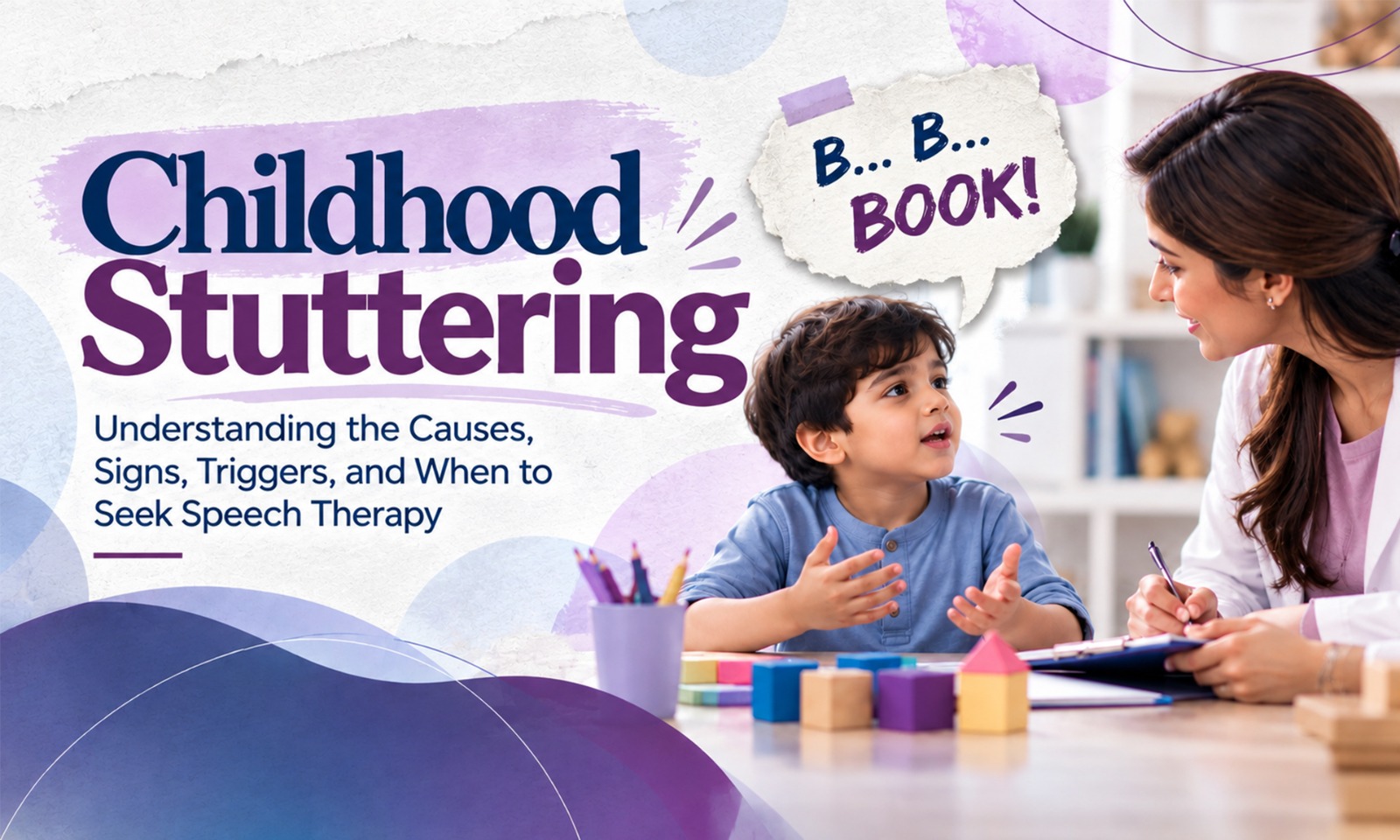
Hearing your child repeat sounds, suddenly get stuck, or stretch words while speaking can be troubling. Parents often question: Is this a normal part of speech development, or does my child need speech therapy?
Childhood stuttering is a speech smoothness disorder that starts between the ages 2 and 6, when children are speedily developing their speech and language skills. Many children know how periods of disfluency and later speak smoothly, while some continue to stutter and may take advantage from professional assistance.
Understanding what childhood stuttering resembles, what can make it more evident, and when to inquire a speech-language pathologist can help parents respond suitably– without putting unnecessary pressure on the child.
What is Childhood Stuttering?
Stuttering is an interruption in the natural flow of speech. A child who stutters may:
Stretch a sound , such as “mmmmom”
Repeat sounds or syllables, such as “b-b-b-ball”
Get stuck or experience a block, where the child knows that they want to say but the word does not come out
Pause or struggle while trying to produce a word
Repeat whole words.
Some children may also show physical signs of effort, such as facial tension, blinking, or movements of the lips or body while trying to speak.
Significantly, stuttering does not mean that a child does not know what they want to say. The difficulty is with the flow of speech, without avoiding the child’s ideas or understanding.
Is Stuttering Normal in Young Children?
Not every period of stammering speech means a child has a stubborn stuttering problem.
Young children may repeat words or phrases, pause, or revise what they are saying while evolving language. Some children know developmental stuttering for a specific period of time and then it becomes fluent. NIDCD reports that stuttering most ordinarily begins between ages 2 to 6 and that many children ultimately recover from it.
However, it is not always feasible for parents to know if a child’s stuttering will vanish on its own.
That’s why looking at the general pattern matters more than counting individual repetitions.
A speech-language pathologist can judge the child’s language abilities, speech, stuttering behaviours, history, and reactions to communicate to decide if further monitoring or therapy may be suitable.
Signs of Stuttering Parents Should Watch For
Some usual signs of childhood stuttering involves:
1. Sound repetitions
The child repeats the starting of a word:
“M-m-m-mom,look!”
2. Syllable repetitions
The child repeats part of a word:
“Ba-ba-ba-ball.”
3. Word repetitions
A child may repeat a complete word:
“I-I-I want that.”
4. Prolongations
A sound may be stretched:
“Sssssun.”
5. Blocks
The child may seem to be trying to speak, but no sound comes out for a moment.
6. Physical tension or struggle
Some children may tense their face, blink, move their head, or use other movements while trying to get a word out.
7. Avoidance
Other children may start avoiding some words, situations, or speaking chances because they are concerned about stuttering.
These signals can differ from child to child and can also change trusting on the situation.
What Causes Childhood Stuttering?
There is no single known cause of developmental stuttering.
Current proof suggests that stuttering is multifactorial, involving a fusion of genetic and neurophysiological factors. Stuttering can also run in families.
This is essential for parents to understand:
Your parenting did not cause your child’s stuttering.
Emotional problems and parenting approaches are not considered causes of developmental stuttering. However, environmental factors and speaking demands can influence how obvious a child’s disfluency is.
So blaming yourself — or your child— is not helpful.
The more versatile question:
“How can we make communication easier and more comfortable for our child?”
What Can Trigger or Increase Stuttering?
Stuttering can shift from one situation to another. A child may sound more smooth at one moment and stutter more noticeably at another.
Some situations that may increase disfluency includes:
Having a lot to say
Speaking in front of a group
Competitive or fast-paced conversations
Stress or anxiety
Feeling pressure to answer quickly
Talking quickly
Being rushed
Excitement
This does not mean that stress or excitement creates the underlying stuttering disorder. Rather, these situations can make existing disfluencies more noticeable.
Interestingly, stuttering can sometimes decrease during activities such as reading, singing, or speaking together with another person.
When Should Parents Seek Speech Therapy for Stuttering?
One of the biggest questions parents ask is:
“Should I wait and see if my child grows out of it?”
There is no single rule that relates to every child.
A speech-language evaluation is particularly worth considering when:
The child becomes frustrated or upset when speaking
The child shows physical struggle or tension
The child has other speech or language difficulty
There is a family history of persistent stuttering
Parents are concerned about the child’s communication
Stuttering has continued for several month
Stuttering appears to be increasing
The child starts avoiding talking
NIDCD notes that healthcare professionals generally suggest evaluation when a child has stuttered for 3-6 months, shows stutter behaviors, or has a family history of stuttering or related communication disorders. ASHA also suggests assessments when stuttering is suspected , particularly when concerns or negative reactions are present.
You do not need to wait until stuttering becomes extreme before asking for professional guidance.
An evaluation can help choose if monitoring, parents guidance, or direct intervention is suitable.
Visit: Speech Therapy in Pune
What Happens During a Speech Therapy Assessment?
A speech-language pathologist does more than simply count how many times a child stutters.
The assessment may consider:
When the stuttering began
How frequently it occurs
Situations in which stuttering increases or decreases
Physical struggle or tension
Speech and language development
The child’s reactions to stuttering
Family history
Communication at home and other settings
The target is to understand the whole child and their communication experience, not just the number of stutters.
How Can Parents Support a Child Who Stutters?
Parents can communicate more contented without turning every conversation into a speech exercise
Give Your Child Time to Finish
Avoid hurrying your child or completing their sentences. Allow them to convey their thoughts at their own speed without feeling pressured to speak smoothly.
Speak Slowly and Naturally
Model a calm, relaxed speaking pace during everyday conversations. Serene pauses can reduce conversational pressure without making your child feel that their speech needs remedy.
Avoid Criticism and Unwanted Corrections
Comments such as “Speak properly”, “Take a deep breath”; or “Think before you speak”, may increase pressure. Rather, respond to the meaning of the child’s message.
Listen to What Your Child Says
Focus on your child’s message instead of how they speak. Keep natural eye contact, show interest, and respond to their thoughts rather than drawing attention to moments of stuttering.
Encourage Confidence and Self-Expression
Applaud your child’s creativity, ideas, and willingness to communicate instead of their fluency. Encourage them to participate in conversations and express themselves without fear of judgement.
Create a Relaxed Speaking Environment
Reserve a few minutes every day for relaxed, one-on-one conversations. Decrease distractions, such as mobile phones and televisions, and give your child your utmost attention.
Myths and Facts About Childhood Stuttering
Myth: Stuttering happens because a child is nervous.
Fact: Developmental stuttering is a complicated speech fluency disorder. Nervousness may affect how clear it is, but it is not considered its basic cause.
Myth: Children will always be left behind stuttering.
Fact: Some children recover naturally, while others continue to stutter. Professional evaluation can help identify necessary risk factors and guide decisions about support.
Myth: Parents should correct every stutter.
Fact: Regular correction can make a child feel self-conscious. Supportive listening and guidance from a speech-language therapist are more suitable.
Myth: A child who stutters has low intelligence.
Fact: Stuttering does not indicate low intelligence. Children who stutter can have the same range of intellectual abilities as other children.
Myth: A child who stutters has low intelligence.
Fact: Stuttering does not show low intelligence. Children who stutter have the same range of scholar abilities as other children.
Myth: Children should avoid public speaking and social activities.
Fact: Avoiding communication may restrict participation and confidence. Children should be supported in stating themselves and taking part in activities they enjoy.
Frequently Asked Questions
1. At what age does stuttering usually begin?
Developmental stuttering commonly begins between 2-6 years of age, usually during preschool years. However, onset can vary, and an individual assessment may be needed to understand a child’s speech difficulties.
2. Can childhood stuttering go away on its own?
Yes, some children heal naturally. Others continue to stutter. A child’s age at onset, family history, duration of stuttering, and speech patterns may help a qualified professional assess the likelihood of persistence.
3. Does watching television or using mobile phones cause stuttering?
There is no found evidence that ordinary television viewing or mobile phone use directly causes developmental stuttering. However, extreme screen time can reduce opportunities for interactive conversation, so balanced screen habits and regular face-to-face communication are beneficial.
4. Should parents ignore stuttering?
Parents should not punish, shame, or continuously correct a child for stuttering. However, ignoring constant difficulty or signs of distress is not available. Consult a professional assessment if you have concerns.
5. How long does speech therapy take?
The span depends on the child’s age, stuttering patterns, individual needs, and response to intervention. Some children benefit from a relatively short period of support, while others need longer-term therapy or periodic follow-up.
6. Is childhood stuttering curable?
Some children recapture naturally, and many benefit from suitable intervention. However, there is no assured cure for every child. Treatments targets to improve communication, reduce speaking difficulty where possible, and support confidence and participation.
7. Can parents help a child who stutters at home?
Yes, parents can support comfortable communication by allowing the child to finish speaking, listening patiently, reducing unnecessary pressure, and avoiding unnecessary corrections. A speech-language therapist can suggest strategies matched to the child’s specific needs.
Conclusion
Childhood stuttering can impact a child’s communication, confidence, and social interactions. Understanding the signs early, responding with patience, and looking for professional guidance when needed can help children communicate more comfortably. Remember, the target is not just fluent speech but helping every child express their thoughts without fear or pressure.
At SynapCare Rehabilitation Centre, we offer speech therapy support tailored to children’s individual communication needs.
Contact SynapCare to learn how the right guidance can support your child’s communication journey.